Allocate an Array Dynamically, Read From File, Sort, and Print Array C++
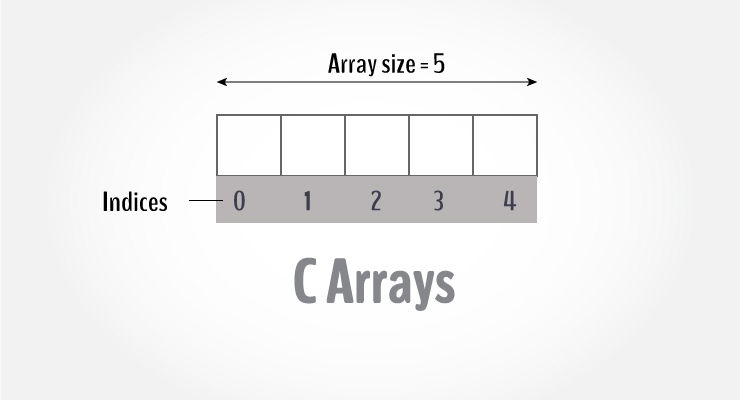
An array is a variable that tin store multiple values. For example, if you lot want to shop 100 integers, you tin can create an array for it.
int information[100]; How to declare an array?
dataType arrayName[arraySize];
For example,
float mark[5];
Here, nosotros declared an array, mark, of floating-signal type. And its size is v. Meaning, information technology tin concur 5 floating-point values.
It's important to annotation that the size and blazon of an array cannot exist changed in one case it is declared.
Access Array Elements
You can access elements of an assortment by indices.
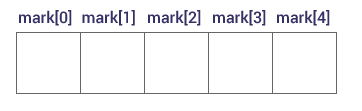
Suppose you declared an assortment mark every bit higher up. The commencement chemical element is mark[0], the second element is marker[1] and so on.
Few keynotes:
- Arrays have 0 as the first index, non 1. In this example, marker[0] is the first chemical element.
- If the size of an array is n, to access the terminal element, the
n-1index is used. In this instance, mark[4] - Suppose the starting address of
mark[0]is 2120d. And then, the accost of themarker[1]will exist 2124d. Similarly, the address ofmark[two]will be 2128d so on.
This is because the size of afloatis four bytes.
How to initialize an array?
Information technology is possible to initialize an array during declaration. For example,
int mark[5] = {19, ten, 8, 17, nine}; Y'all can also initialize an array like this.
int marking[] = {19, ten, 8, 17, 9}; Here, nosotros haven't specified the size. Nonetheless, the compiler knows its size is 5 as we are initializing it with 5 elements.
Here,
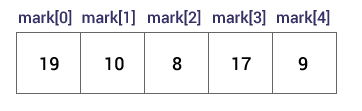
mark[0] is equal to 19 marking[1] is equal to 10 mark[ii] is equal to eight marker[iii] is equal to 17 mark[4] is equal to 9
Change Value of Array elements
int marking[5] = {19, ten, 8, 17, 9} // make the value of the third element to -1 mark[two] = -1; // make the value of the fifth element to 0 mark[iv] = 0; Input and Output Assortment Elements
Here's how you can accept input from the user and store it in an array element.
// have input and store information technology in the 3rd element scanf("%d", &mark[2]); // take input and store it in the ith chemical element scanf("%d", &mark[i-1]); Here's how you can print an private element of an assortment.
// impress the first element of the array printf("%d", mark[0]); // print the third element of the assortment printf("%d", mark[2]); // print ith chemical element of the assortment printf("%d", mark[i-1]); Example one: Array Input/Output
// Programme to take 5 values from the user and store them in an assortment // Print the elements stored in the array #include <stdio.h> int main() { int values[v]; printf("Enter 5 integers: "); // taking input and storing it in an array for(int i = 0; i < v; ++i) { scanf("%d", &values[i]); } printf("Displaying integers: "); // printing elements of an array for(int i = 0; i < v; ++i) { printf("%d\n", values[i]); } return 0; } Output
Enter 5 integers: ane -iii 34 0 3 Displaying integers: 1 -iii 34 0 3
Here, we take used afor loop to take 5 inputs from the user and store them in an array. Then, using anotherfor loop, these elements are displayed on the screen.
Example 2: Summate Average
// Plan to find the average of n numbers using arrays #include <stdio.h> int main() { int marks[10], i, n, sum = 0, average; printf("Enter number of elements: "); scanf("%d", &north); for(i=0; i < north; ++i) { printf("Enter number%d: ",i+1); scanf("%d", &marks[i]); // adding integers entered by the user to the sum variable sum += marks[i]; } average = sum / n; printf("Boilerplate = %d", average); return 0; } Output
Enter n: 5 Enter number1: 45 Enter number2: 35 Enter number3: 38 Enter number4: 31 Enter number5: 49 Average = 39
Hither, we have computed the average of due north numbers entered by the user.
Access elements out of its spring!
Suppose you alleged an array of ten elements. Let's say,
int testArray[10];
You can admission the array elements from testArray[0] to testArray[9].
Now let's say if you lot try to access testArray[12]. The element is not available. This may cause unexpected output (undefined behavior). Sometimes you might get an mistake and another time your program may run correctly.
Hence, you should never admission elements of an array outside of its bound.
Multidimensional arrays
In this tutorial, you learned about arrays. These arrays are called one-dimensional arrays.
In the side by side tutorial, you will learn about multidimensional arrays (assortment of an array).
Source: https://www.programiz.com/c-programming/c-arrays

Post a Comment for "Allocate an Array Dynamically, Read From File, Sort, and Print Array C++"