Did Greece Win Agains Turks After the Ottoman Empire?
One hundred years ago this calendar month, the Greco-Turkish war erupted. The state of war resulted in the largest compulsory population commutation in history up to that time (2 one thousand thousand people) and helped define the concept of ethnic conflict. The war besides brought well-nigh the Turkish Democracy and its severity indelibly shaped modern Hellenic republic and Turkey to this day.
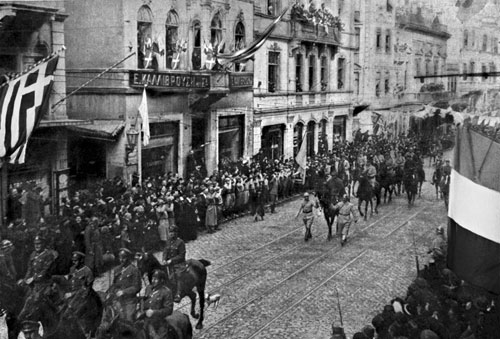
Allied troops occupying Constantinople marching forth the Grande Rue de Péra.
The armistice of 11 November in 1918 is credited for ending the fighting of the Offset World War, just just twelve days prior, the Allied Powers and the Ottoman Empire signed the Ceasefire of Mudros. The Ottoman Empire was to be partitioned amongst the Allies, with all powers sending contingents to occupy Constantinople. As part of the bargain, Greece received the city of Smyrna.
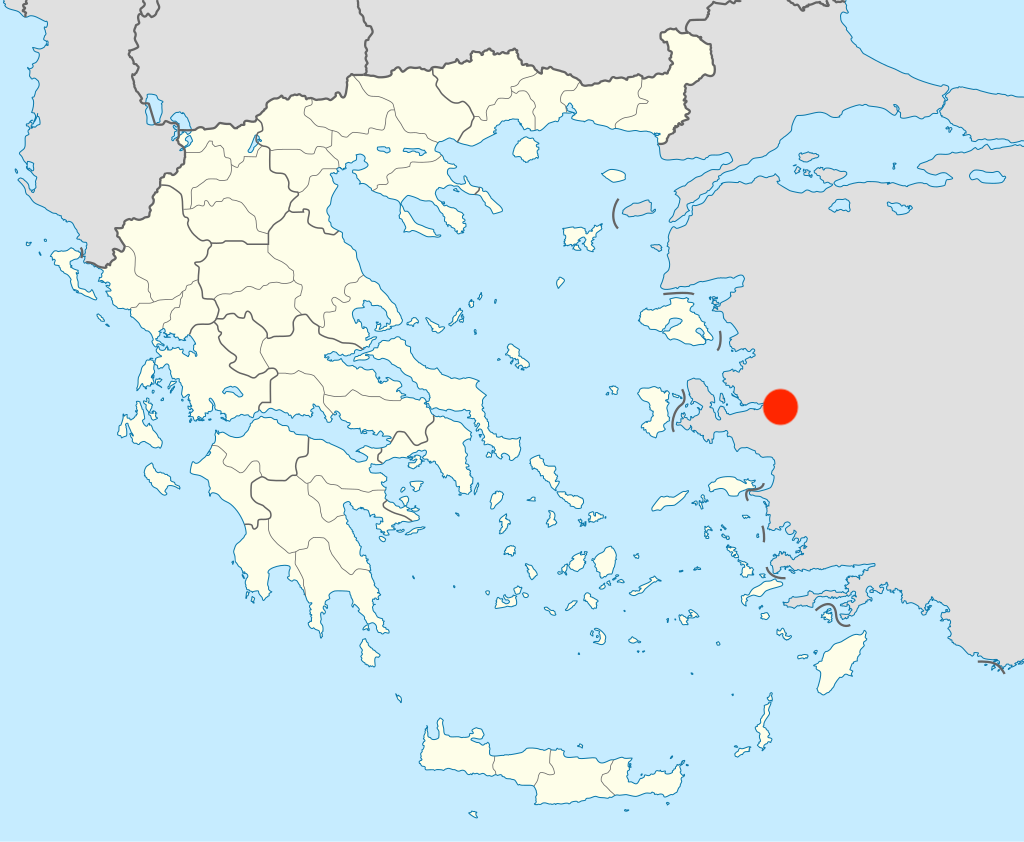
Smyrna was a wealthy metropolis inhabited mostly by minorities in the Ottoman Empire: Greeks, Jews, and Armenians. For Greece, the city was more than simply a prize for participation in World War I. It validated the Greek foreign policy goal of capturing Constantinople and reviving the Byzantine Empire, or "Greater Greece" as they called it.
Greek troops landed in Smyrna on May xv, 1919 and the war began. Local ethnic Greeks and Armenians joined forces with Greek troops. Reports soon circulated that these untrained volunteers committed acts of violence against their Muslim neighbors. Rumors of such brutality enraged an already growing revolutionary faction inside the Ottoman Empire led past Mustafa Kemal Atatürk.
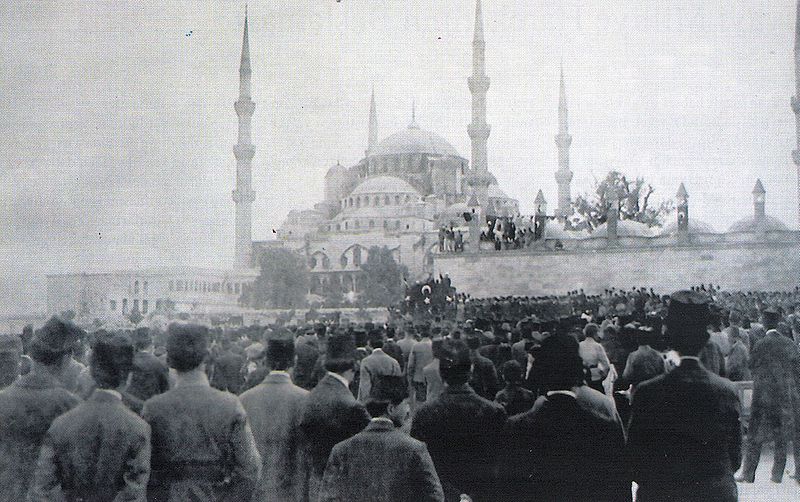
A 1919 demonstration in Istanbul protesting the Allies' occupation.
Initially, the Greek Army's intent was to secure the region surrounding the Smyrna occupation zone, merely by the summer of 1920, Greek forces eyed Ankara and began to push button deep into the heart of Anatolia. Britain backed this move into Turkish lands considering it saw the Greek armed services as a conduit to crush Kemal's revolutionary motion. By October of 1920, Greek troops had gained control of northwestern Anatolia. This advance, even so, was met with staunch resistance.
Turkish revolutionary forces using guerilla warfare slowed the Greek Ground forces'southward progression, and Greek soldiers' acts of violence confronting Muslim villagers created fear and panic and fueled ethnic conflict. In acts of reprisal, revolutionary forces brutally murdered Greek Orthodox villagers and forced many others to drift east to the Greek occupation zone.
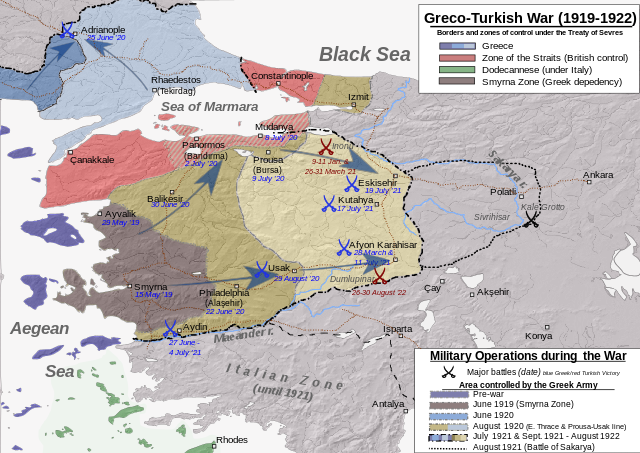
A map detailing the zones of command during the war.
The fierce acts against civilians committed by both sides did not go unnoticed past the international community and spawned numerous humanitarian relief campaigns.
Every bit the fight dragged on, the Greek public grew weary of the state of war, and troop morale declined speedily. Greek desertions soared.
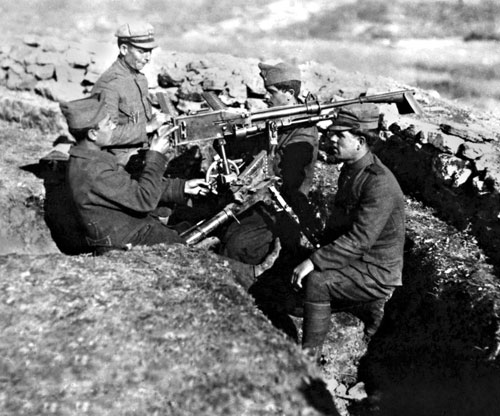
Britain, broken-hearted about the perceived instability of the Greek government, withdrew its support. Into this vacuum, the Soviets began providing munitions to the revolutionary forces in an effort to check Western expansion and turned the tide of war in favor of Kemal's forces.
By 1921, the Greek accelerate had stalled. The Boxing of Sakarya in Baronial saw heavy losses for the Greeks and was a strategic victory for the Turkish National Movement. For the Greek forces, this defeat completely halted whatsoever hope for advances and sent shockwaves through the authorities in Athens. After a heated parliamentary contend, the government decided it was far also invested to end the state of war. Plus, conceding defeat meant that Greece forfeited its territorial claims to Smyrna. This determination would show disastrous.
Sakarya was the kickoff of the stop for the Greek campaign. The Greeks were forced to begin a slow retreat toward Smyrna. The final death knell came in August, 1922 with the Turkish Great Offensive—over 100,000 Turks pitted against a disorganized Greek contingent of 200,000.
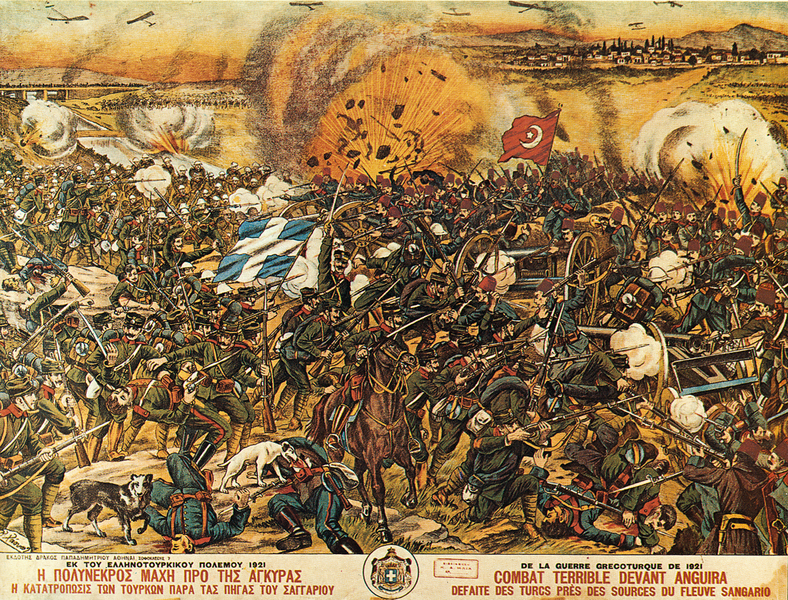
A Greek depiction of the Battle of Sangarios River (or Battle of Sakarya) in 1921.
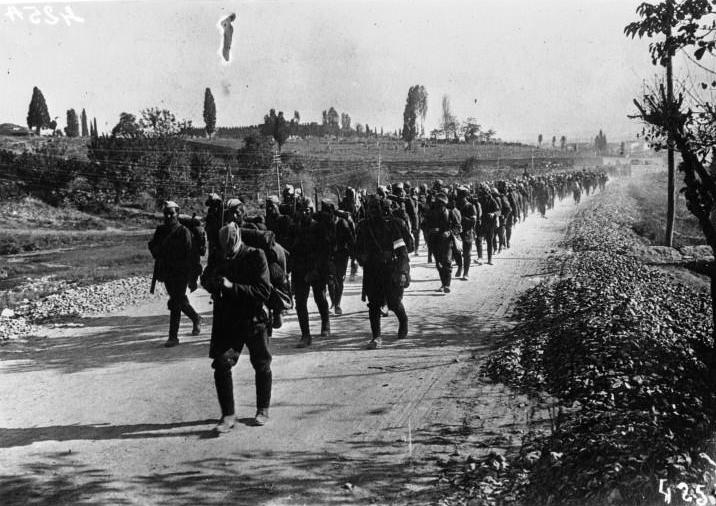
Greek soldiers retreating in 1922.
The military performance lasted 24 days and essentially crushed the Greek army, forcing a jerky retreat. The revolutionary forces captured xv,000 prisoners of war and encircled numerous divisions every bit they tailed the Greek troops to the declension. The Dandy Offensive concluded when the revolutionary forces entered Smyrna and the metropolis erupted in flames.
Thousands of Greek and Armenian refugees, besides equally Ottoman Turks fled in horror, jumping into the sea to escape the fire. The scene was terrifying, as one British sailor described information technology watching from the deck of the HMS King George: "At that place were the well-nigh atrocious screams 1 could imagine… It was a horrible scene; mothers with their babies, the fire raging over their heads… and the people all screaming."
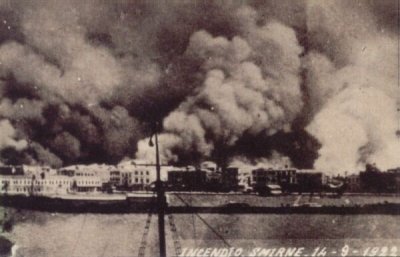
The view of the Smyrna fire in September 1922 from an Italian transport.
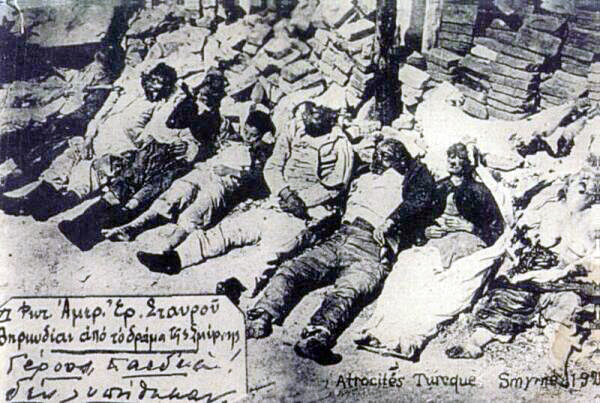
Victims of the Smyrna fire in September 1922.
It took nine days to extinguish the fire, and nearly 100,000 people perished in the flames. The bang-up Ottoman city of Smyrna was reduced to ash. It was the end of the Greco-Turkish War and of a vision of a Greater Greece.
For Kemal and his supporters, the victory was the nascence of the Turkish Commonwealth. Kemal abolished the sultanate to become the first leader of the new republic.
With the war over, the international customs started peace negotiations. Great britain, France, Italian republic, and others leading the peace talks decided that a compulsory population exchange was necessary to prevent the deaths of more than innocent civilians.
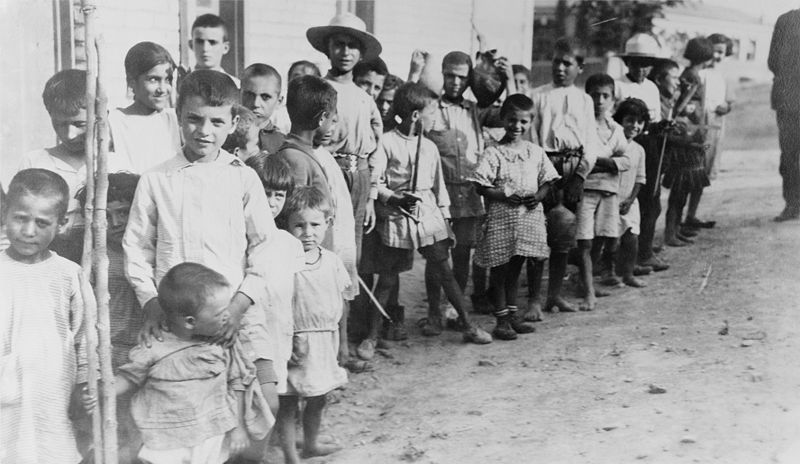
Refugee children from Turkey in Greece in 1923.
With the Treaty of Lausanne in 1923, one.5 million Orthodox Christians and 500,000 Muslims were forced to get out their homes. This population exchange put tremendous financial pressure on an already destabilized Greece, as the country had to care for 1.five million new refugees. At the same fourth dimension, information technology created financial issues for Turkey since many wealthy families were required to exit their homes and cross the Aegean.
The exchange solidified the idea of both Hellenic republic and Turkey every bit homogenous nation-states. Although in that location were even so minority communities left out of the exchange, Greece essentially became an Orthodox Christian nation, whereas Turkey became a Muslim Commonwealth. This state of war and the concept of religious homogeneity withal causes tensions between the 2 countries today.
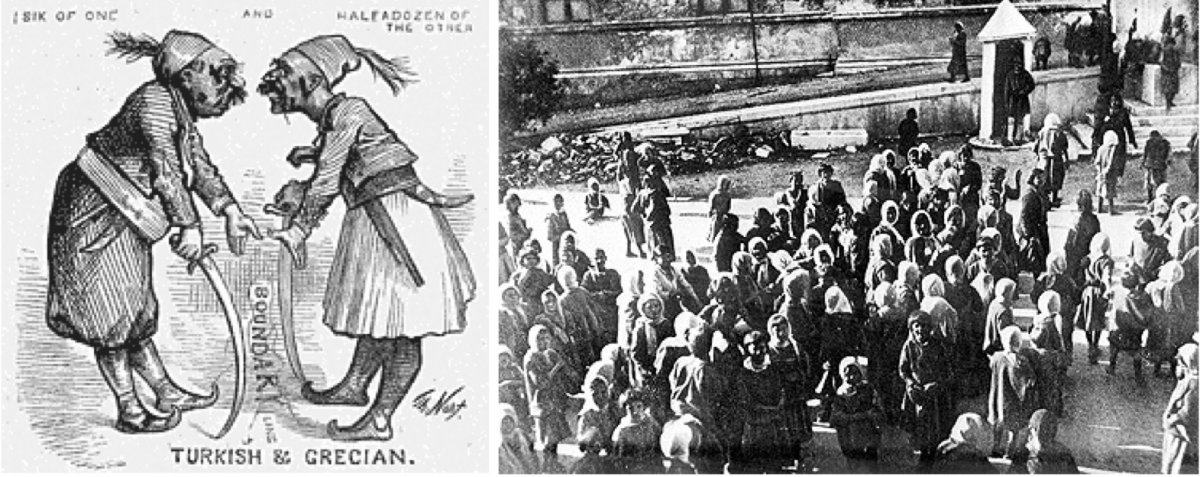
A political cartoon depicting the dispute between Greeks and Turks over borders and population exchange (left). Muslim refugees during the population exchange in 1923 (right).
As we approach the centenary of the Greco-Turkish State of war, we should take the time to reverberate on its causes and outcomes and the warnings they give us today. With instability in both the Middle East and Eastern Europe, and the rise of nationalism globally, information technology may be merely a matter of time before another powder keg erupts. In our current climate of religious intolerance, nosotros should marking this anniversary past remembering how innocent people were targeted because of their beliefs.
Source: https://origins.osu.edu/milestones/may-2019-greco-turkish-war-smyrna-sakarya-kemal-ottoman?language_content_entity=en

Post a Comment for "Did Greece Win Agains Turks After the Ottoman Empire?"